Resources
Resources addressing topics of interest to individuals with developmental disabilities, their caregivers and professionals in the field.
Resources from the Florida Developmental Disabilities Council are available on a variety of topics to provide information, training, information and insight on topics relevant to individuals with intellectual and developmental disabilities their caregivers and professionals in the field.
FDDC RESOURCES
Listed below are the council’s most requested resources.
Tools
Best Practices in Case Management Materials
The resources below are for people with intellectual and developmental disabilities, their families and caregivers, and professionals who help plan, coordinate, and provide services. Case management helps people understand their options, make choices, connect with services, and get the supports they need to live, work, learn, and participate in their communities.
Everyone’s needs, goals, and preferences are different. Good case management should be person-centered, respectful, and focused on helping each person have more choice, independence, and control over their life. These materials include information, tools, and things to think about that can help individuals, families, caregivers, case managers, supervisors, and service organizations better understand and use best practices in case management.
For Individuals with Intellectual and Developmental Disabilities, Families & Caregivers
Documents

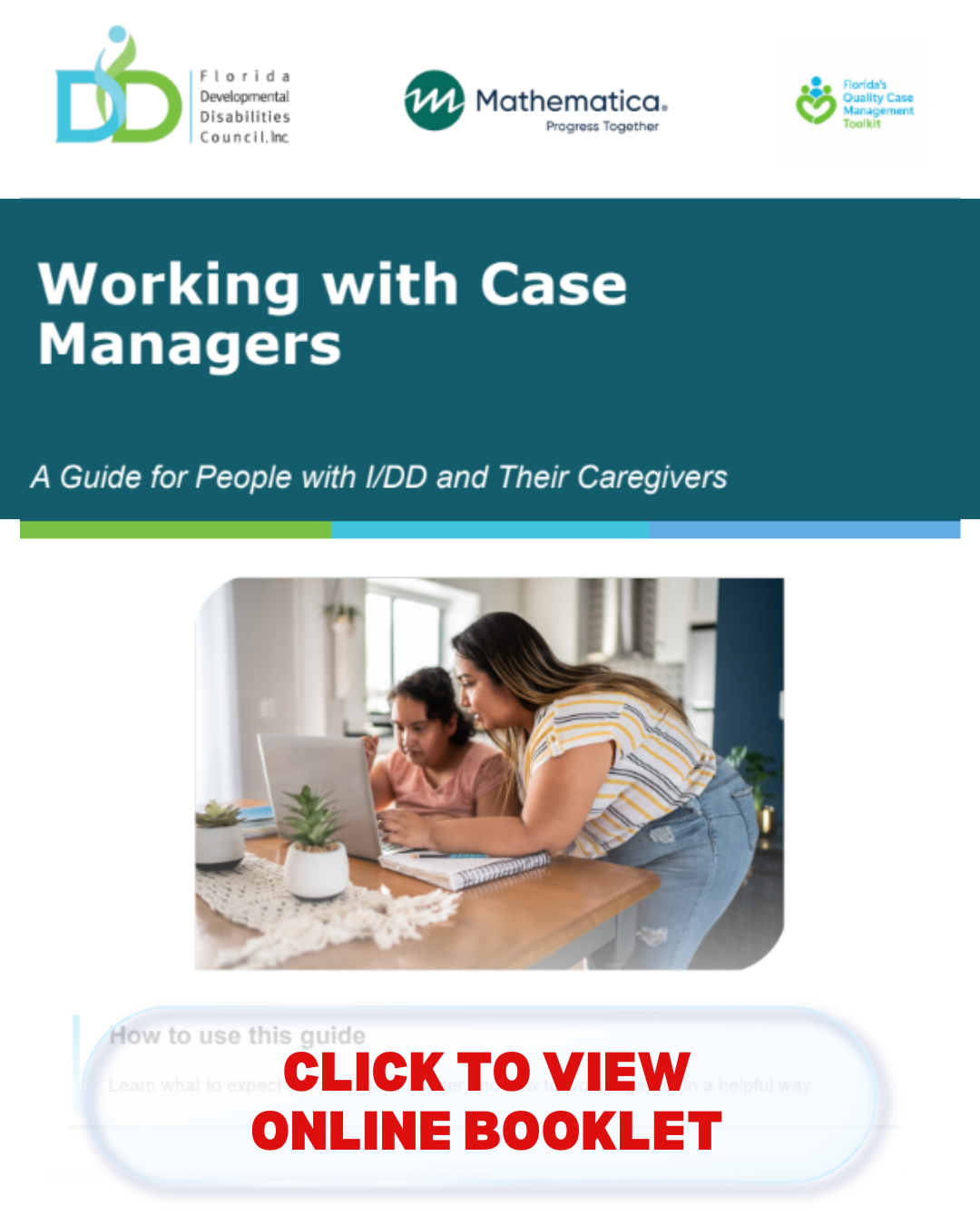
Working with Case Managers: A Guide for People with I/DD and their Caregivers
A guide for people with I/DD and caregivers explaining what to expect from case management and how to use the Florida’s Quality Case Management Toolkit
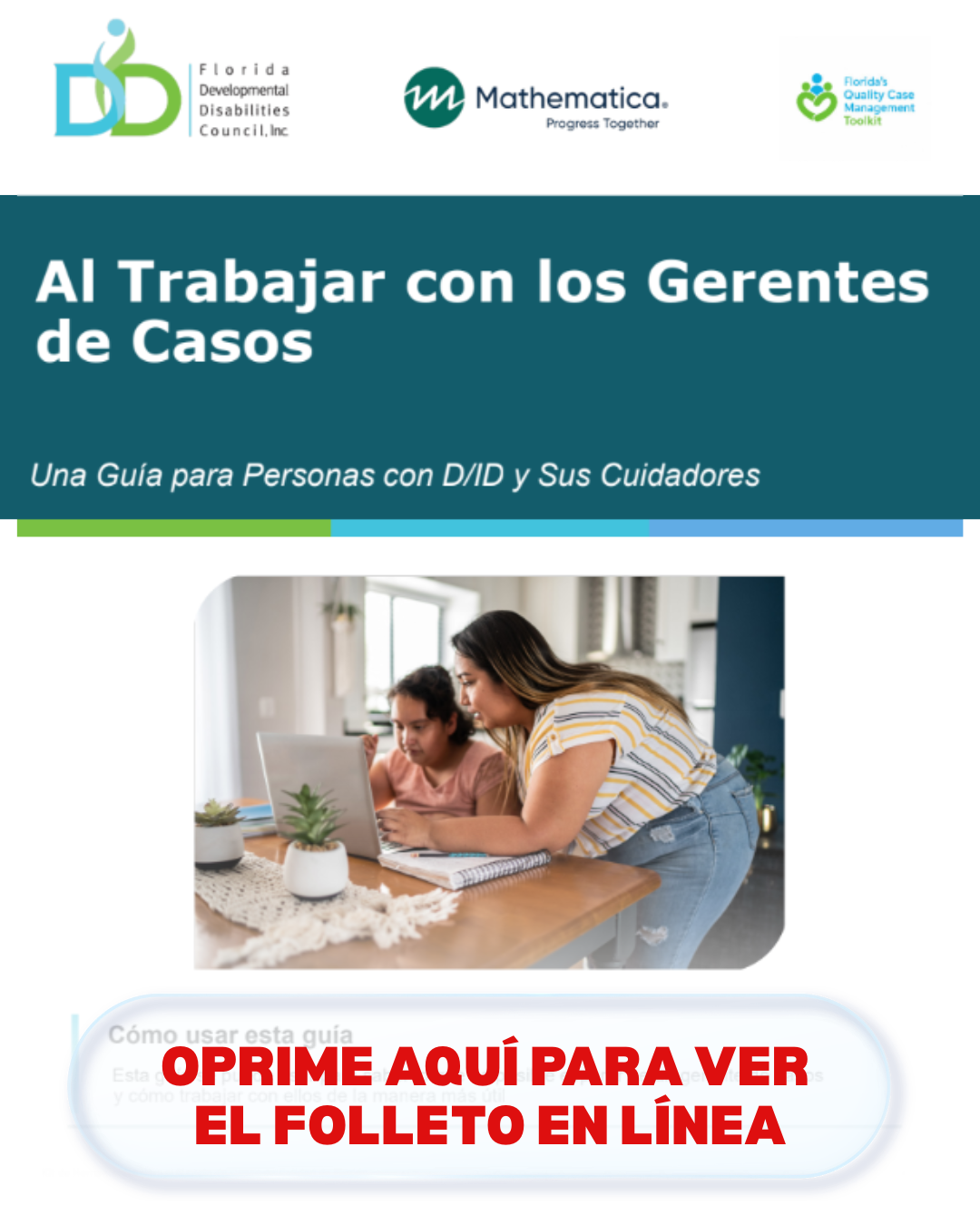
Al Trabajar con los Gerentes de Casos: Una Guía para Personas con Discapacidad Intelectual y del Desarrollo (D/ID) y Sus Cuidadores
Una guía para personas con D/ID y cuidadores que explica qué esperar de la gestión de casos y cómo usar el Conjunto de herramientas para la gestión de casos de calidad de Florida
The Case Management Competency List
A list with 5 skill areas and 19 key skills that show what good case management looks like.
Lista de Aptitudes para el Manejo de Casos
Una lista de 5 perfiles de destrezas y 19 aptitudes que describen cómo debe ser un buen manejo de casos.
Case Management Rating Tool for People with I/DD
Printable PDF tool for individuals with I/DD to assess case management quality
Herramienta de Calificación sobre el Manejo de Casos para Personas con D/ID
Herramienta para saber lo que puede esperar de su gerente de casos
Case Management Rating Tool for Caregivers
Printable PDF tool for caregivers to assess case management quality
Herramienta de Calificación sobre el Manejo de Casos para Cuidadores
Herramienta para saber lo que puede esperar del gerente de casos de la persona a quien usted cuida
Case Management Quality Check*
Online tool with summary report of the Case management Rating Tools for People with I/DD and Caregivers, in English.
*Deidentified input is included in Statewide Quality Improvement Data
La Verificación de Calidad sobre el Manejo de Casos
Herramienta en línea con informe resumen de las encuesta de retroalimentación de participantes y cuidadores, en español.
* La información desidentificada se incluye en los datos de mejora de la calidad a nivel estatal
Case Management Discussion Worksheet
A tool to help individuals with I/DD and caregivers share feedback with case managers
Hoja de Trabajo para Comentar sobre el Manejo de Casos
Herramienta de ayuda para comentar sus opiniones con el gerente de casos
Videos
Understanding Case Management
Video explaining the 19 case management competencies
Assessing Your Case Manager
Video explaining how to use the Case Management Rating Tools
Sharing Feedback with Your Case Manager
Video explaining how to use Case Managment Discussion Worksheet
For Professionals (e.g., Case Managers, Supervisors) & Service Organizations
Documents
Supporting Quality Case Management Across Your Organization
A toolkit for agencies that provide case management services, explaining how to use the case management competencies and rating tools to support quality and consistency in case management programs for people with intellectual and developmental disabilities.
Case Manager Self-Reflection Tool
A tool to help you reflect on your performance and growth
Supervisor Evaluation Tool
A tool to support consistent, fair feedback and professional development of case managers
Case Management Quality Self-Check and Review Tool*
Online tool with summary report of the case manager self-reflection and supervisor evaluation tools, in English.
*Deidentified input is included in Statewide Quality Improvement Data
The Case Management Competency List
A list with 5 skill areas and 19 key skills that show what good case management looks like.
Lista de Aptitudes para el Manejo de Casos
Una lista de 5 perfiles de destrezas y 19 aptitudes que describen cómo debe ser un buen manejo de casos.
Videos
Using Case Management Feedback Tools to Support Stronger Relationships and Improve Outcomes
Video explaining the materials in Florida’s Quality Case Management Toolkit to case managers and how you could use them to improve your service delivery
An Organization’s Guide to Implementing Florida’s Quality Case Management Toolkit
Video explaining how the materials in Florida’s Quality Case Management Toolkit could be used to monitor and improve case management quality.
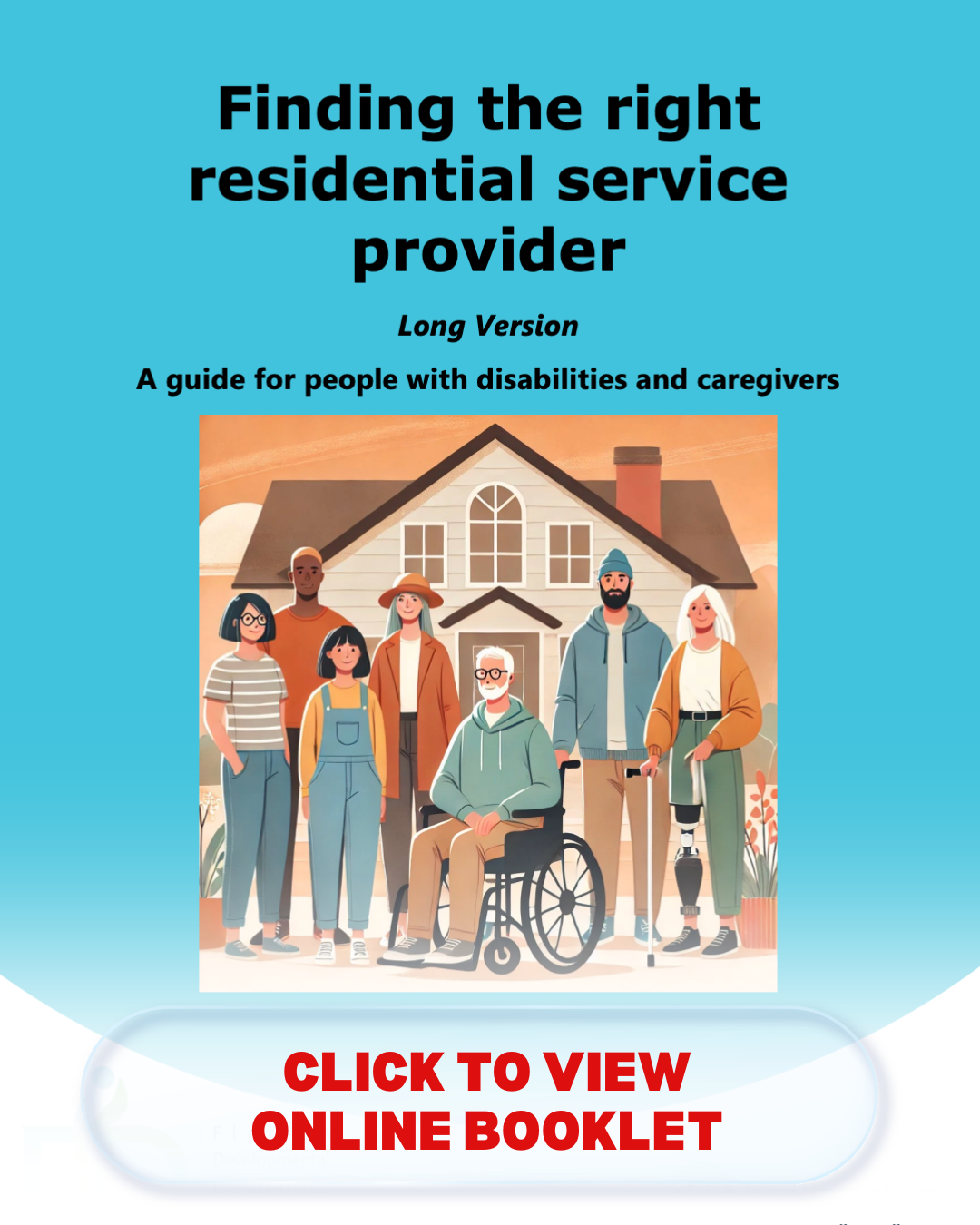
Finding the Right Residential Service Provider
The resources below are for people with disabilities and their caregivers who live in—or are thinking about moving to—a place where they live full-time. These places are called “residential settings.” A residential setting is a home, which could be an apartment, a house, or some other type of place, often with roommates, where people live and get support. These places to live are run by agencies called residential service providers. With the persons who live there, the provider hires the staff, organizes the home, and offers support.
Homes can be different. And providers may have different ways of providing help. This tool helps you get ready to visit different residential settings. It has questions and things to think about to help you decide on the right place for you.
Documents and Videos
Documents
Finding the Right Residential Service Provider: Introduction
Encontrar el Proveedor de Servicios Residenciales Adecuado: Introducción
Finding the Right Residential Service Provider Tool: Short Version
This tool will help you find out if a residential service provider is a good choice for you and decide if a place is right for you. This version has big writing, pictures, and simple language.
Encontrar el Proveedor de Servicios Residenciales Adecuado Herramienta: Versión Corta
Esta herramienta le ayudará a determinar si un proveedor de servicios residenciales es una buena opción para usted y decidir si un lugar es adecuado para usted. Tiene letra grande, varias imágenes y lenguaje sencillo.

Finding the Right Residential Service Provider Tool: Long Version
This tool will help you find out if a residential service provider is a good choice for you and decide if a place is right for you. This version has lots of details, questions to ask, and space to write notes.
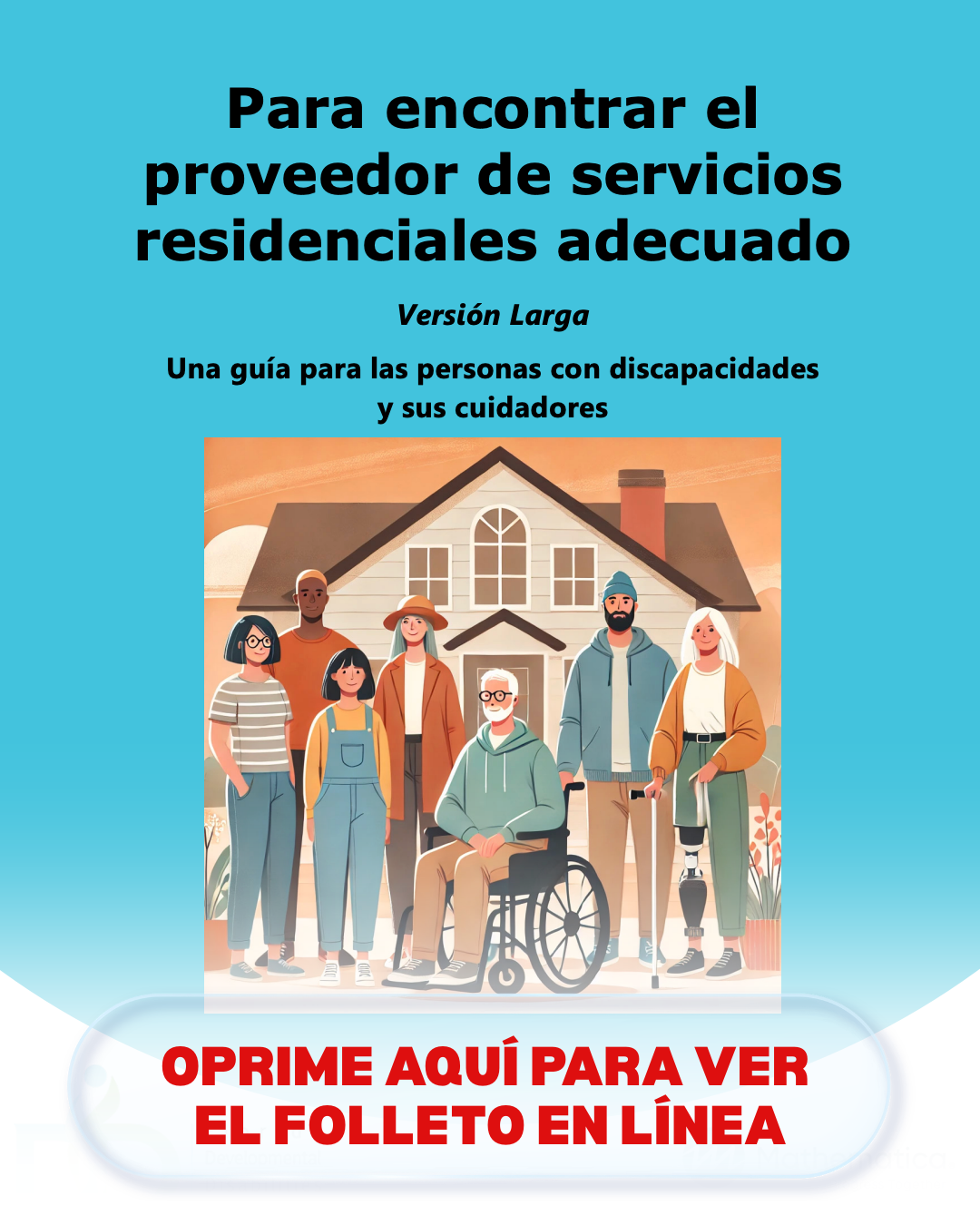
Encontrar el Proveedor de Servicios Residenciales Adecuado Herramienta: Versión Larga
Esta herramienta le ayudará a determinar si un proveedor de servicios residenciales es una buena opción para usted y decidir si un lugar es adecuado para usted. Incluye una gran cantidad de detalles, preguntas que se deben hacer y espacio para escribir notas.
Videos
Introducing the Residential Tool
Video introducing the Residential Tool and its purpose
Using the Residential Tool
Video describing how the Residential Tool can help you find the right place to live
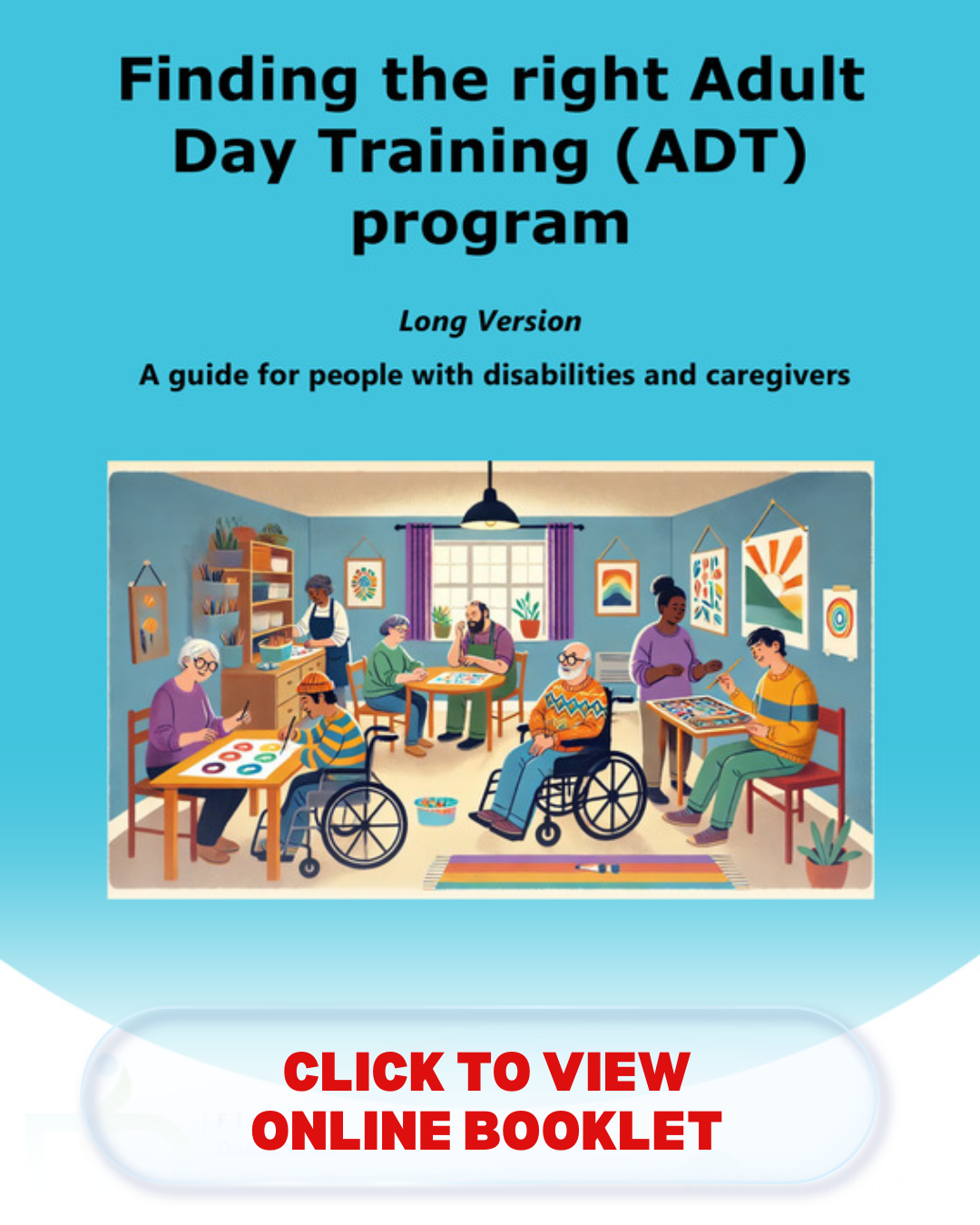
Finding the Right Adult Day Training Program
The resources below are for people with disabilities and their caregivers who participate in—or are thinking about using—Adult Day Training (ADT) programs. ADT programs are community-based programs for people with disabilities. They offer activities that teach important skills like how to take care of yourself, how to be more independent, and how to stay healthy. ADT programs also support social connections and provide opportunities to get involved in your community.
Each ADT program is different. ADT programs offer different supports, activities, and levels of structure. This tool helps you get ready to visit different ADT programs. It has questions and things to think about to help you decide on the right program for you.
Documents and Videos
Documents
Finding the Right ADT Program Tool: Short Version
The tool will help you gather information to assess the fit of an ADT program and decide if a program is right for you. This version has big writing, pictures, and simple language.
Para Encontrar el Programa de Entrenamiento Diurno para Adultos (ADT) Adecuado Herramienta: Versión Corta
Esta herramienta le ayudará a juntar información para poder evaluar si un programa ADT se ajusta a lo que quiere. También le ayuda a decidir si un programa es la mejor opción para usted. Esta versión tiene letras grandes, varias imágenes, y lenguaje sencillo.

Finding the ADT Program Tool: Long Version
This tool will help you find out if a residential service provider is a good choice for you and decide if a place is right for you. This version has lots of details, questions to ask, and space to write notes.
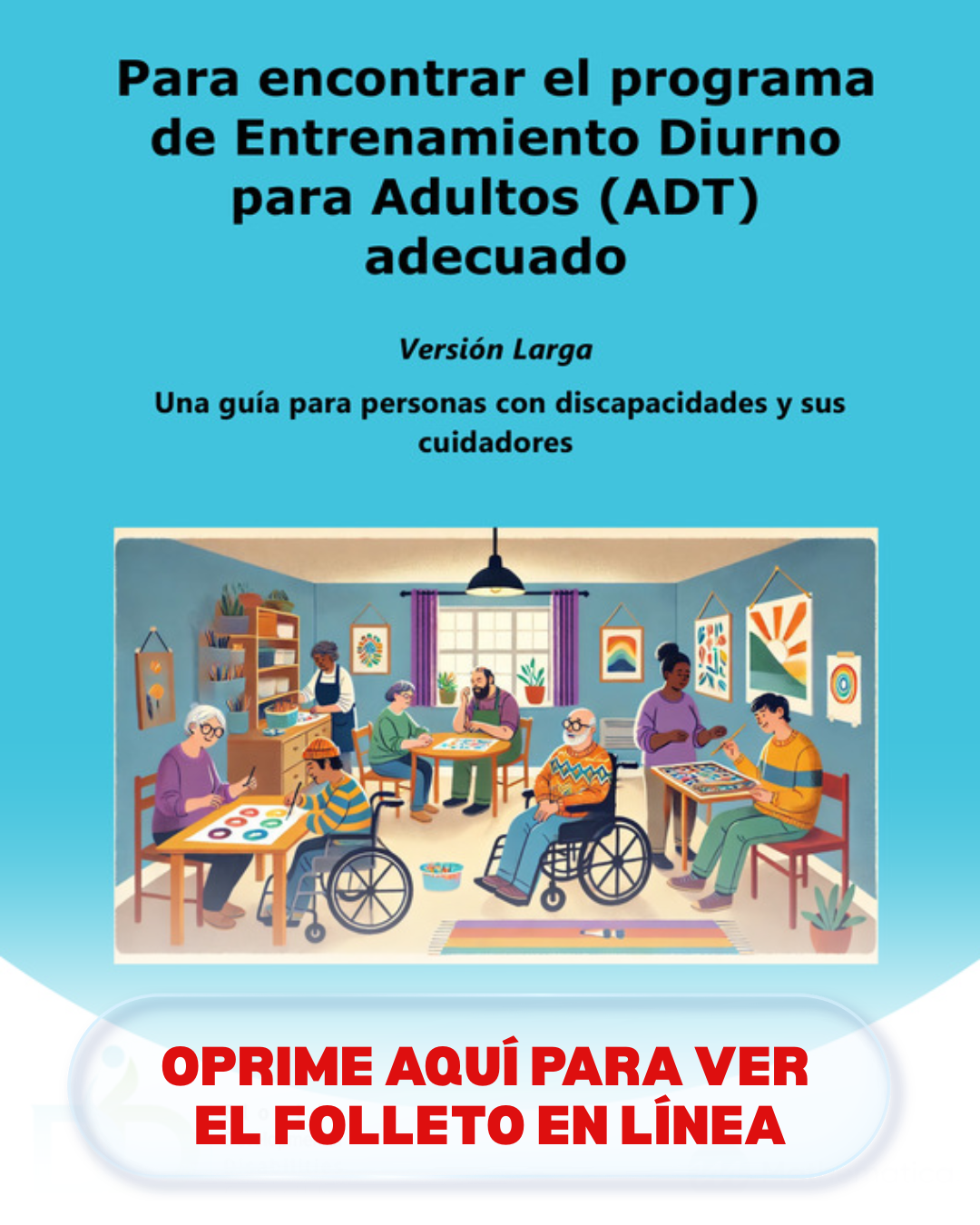
Para Encontrar el Programa de Entrenamiento Diurno para Adultos (ADT) Adecuado Herramienta: Versión Larga
Esta herramienta le ayudará a juntar información para poder evaluar si un programa ADT se ajusta a lo que quiere. También le ayuda a decidir si un programa es la mejor opción para usted. Incluye una gran cantidad de detalles, preguntas que se deben hacer, y espacio para escribir notas.
Videos
COMING SOON
Video description coming soon.
Supported Employment
Coming Soon
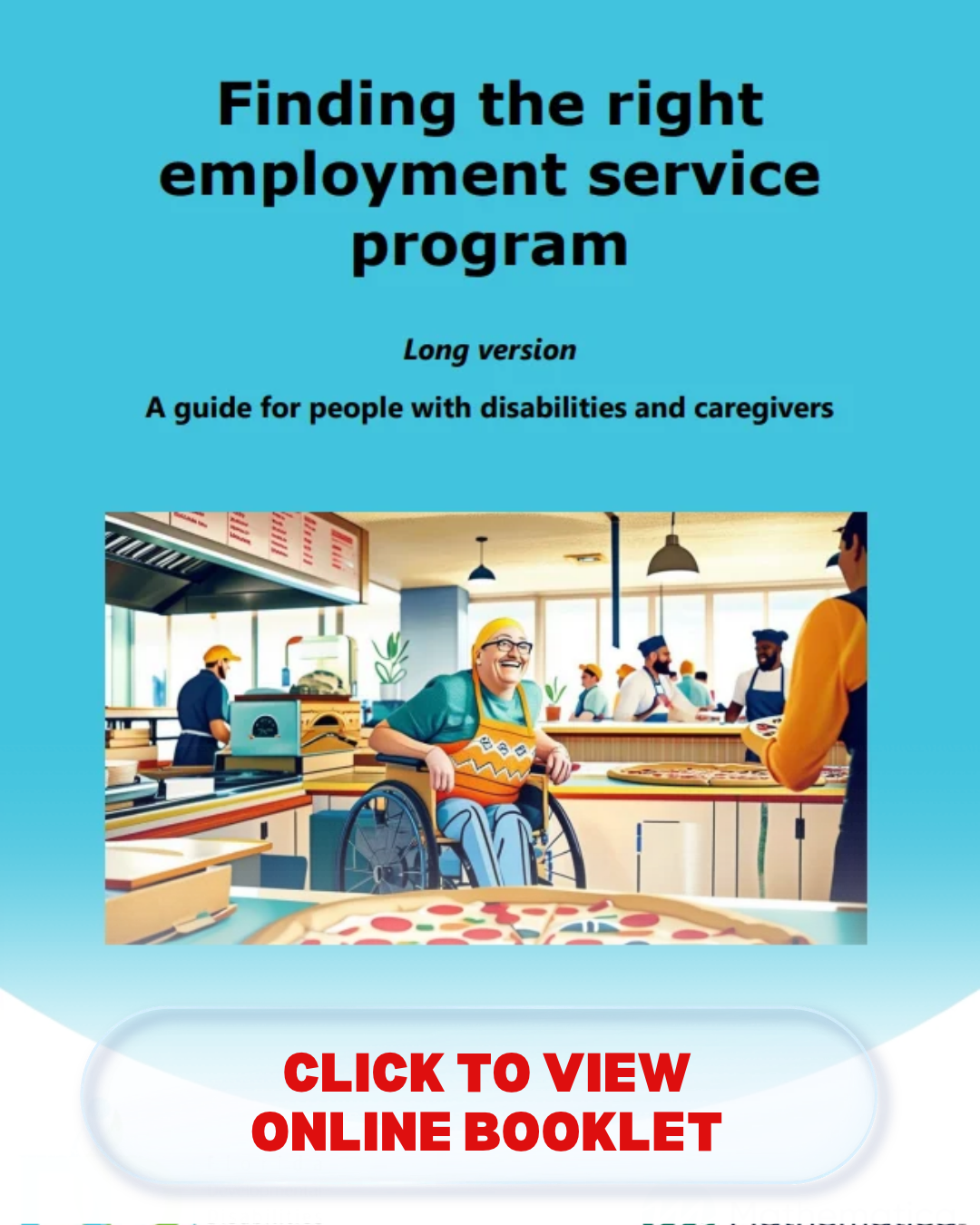
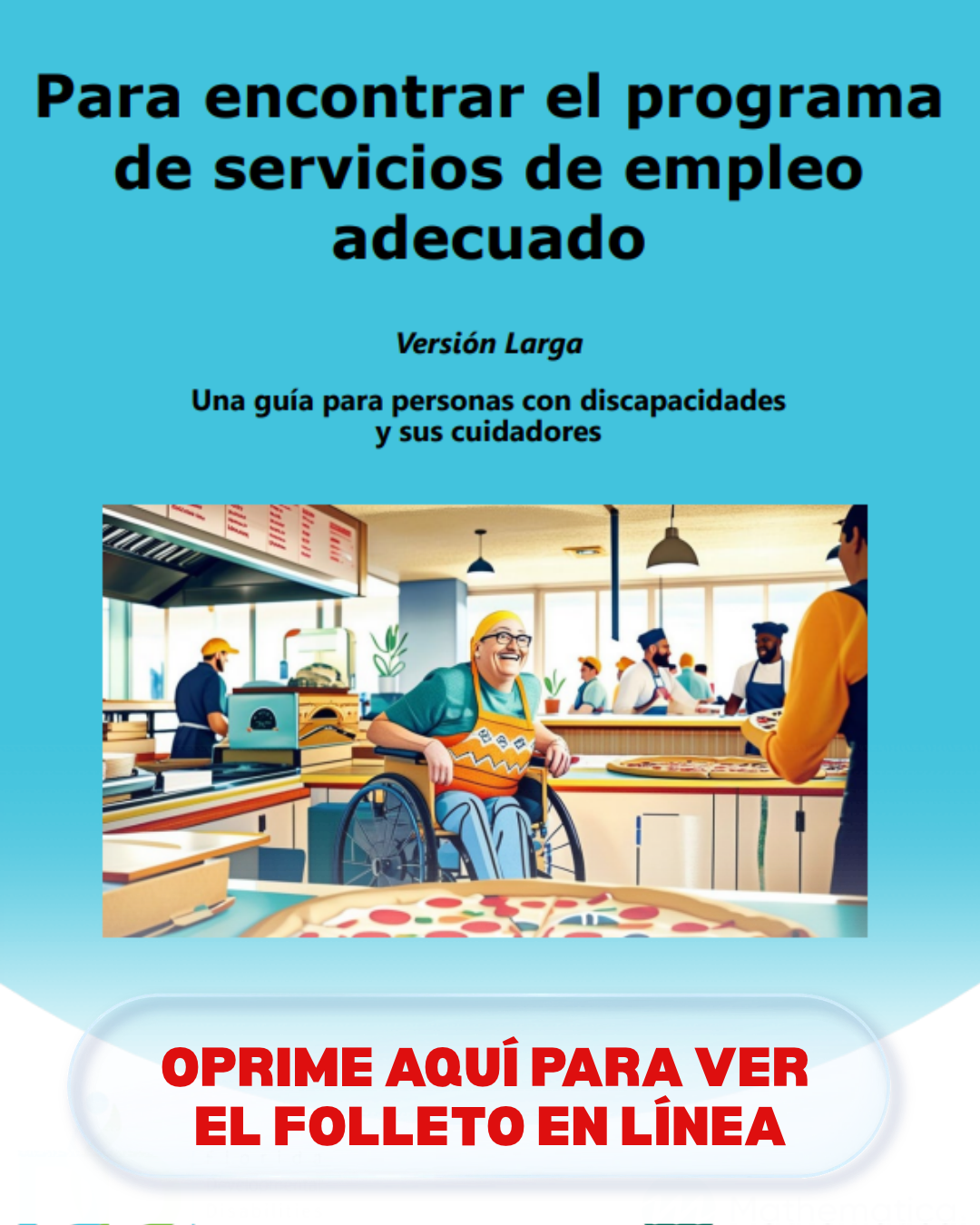
The resources below are for people with disabilities and their caregivers who are exploring work options, starting a job, or building their skills for a future career. Finding a job can be difficult for anyone, but it can be even harder when you’re living with a disability. Employment service providers help people explore career options, learn new skills, find a job, and be successful. Employment services are also referred to as life skills programs, pre-employment transition services, vocational rehabilitation, supported employment, or job training.
Employment services providers offer different types of programs and supports. Some providers are focused on preparing you for a job, while others provide on-the-job support. This tool helps you learn about different employment service providers. It has questions and things to think about to decide if an employment service provider is a good fit for you.
Documents and Videos
Documents
Finding the Right Employment Service Program: Short Version
Para Encontrar el Programa de Empleo Adecuado: Versión Corta
Finding the Right Employment Service Program: Long Version
Para Encontrar el Programa de Empleo Adecuado: Versión Larga
Videos
COMING SOON
Video description coming soon.
Trainings
Coming Soon
Publications
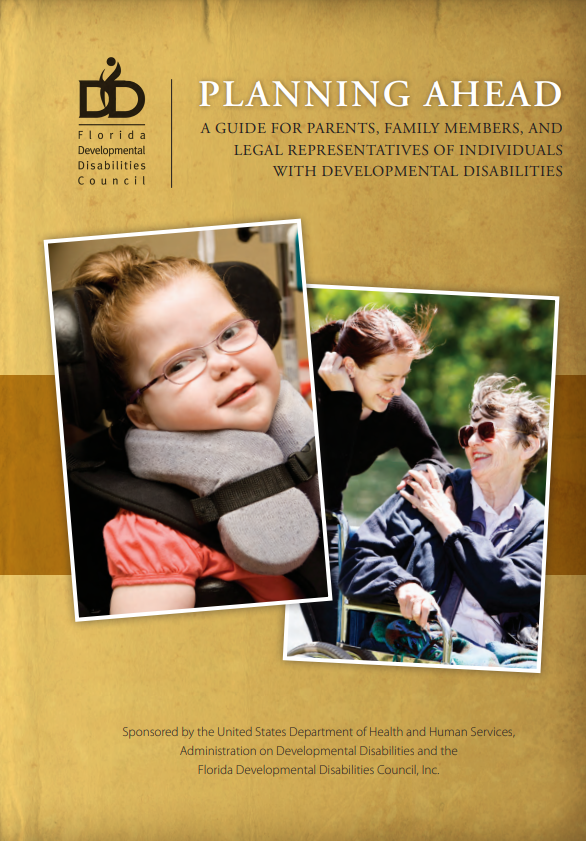
Planning Ahead
A handbook for parents, family members and guardians of adults with developmental disabilities. Provides information that will help identify and plan the direction and future regarding the quality of life family members’ desire. Personal information summary included to ensure the safety and happiness of a surviving family member with a disability.
Click here to download the Planning Ahead PDF (English version)
Descargar el PDF de Planificación con Anticipación (versión en Español)
Advocacy and Leadership Opportunities Guide
A guide for Floridians with intellectual and developmental disabilities and their families to empower strong advocacy and leadership across the state of Florida.
Click here to download the Advocacy and Leadership Opportunities Guide PDF (English version)
Descargar el PDF de la Guía de Oportunidades de Abogacía y Liderazgo (versión en Español)
First Steps Guide: A Guide to Your Child’s Development
Revised in 2017, this is an easy-to-read guide that explains intellectual and developmental disabilities at all stages of life for persons with these disabilities, their families, and other stakeholders. It gives critical information and resources to help these children reach their fullest potential.
Click here to download First Steps Guide PDF (English)
Descargar el PDF de la Guía de Primeros Pasos (Español)
Connections: Tools and Resources for Adult Life
Connections provides information that connects individuals with intellectual and developmental disabilities and their families to tools and resources that will support their transition into adult life.
Click here to download – Connections: Tools and Resources for Adult Life – Illustrated Guide [English] (PDF)
Click here to download – Connections: Tools and Resources for Adult Life – Text Only [English] (PDF)
Descargar el PDF de Conexiones: Herramientas y Recursos para la Vida Adulta (Español)
Easing Your Stress: Information for Caregivers of Individuals with Developmental Disabilities
A publication about stress and stress management for caregivers of individuals with intellectual and developmental disabilities. In its 24 pages, caregivers learn; How the mind-body connect affects their response to stress; How stress affects children; How other caregivers have learned to ease their stress; What resources are available; How to identify approaches that will work for them.
Click here to download the Easing Your Stress (English) PDF
Descargar el PDF de Aliviando Su Estrés (Español)
Stress and What You Can Do About It
A full color book that takes individuals with intellectual and developmental disabilities through a colorful, graphically attractive and easy-to-read lesson in the basics of stress and stress management. Please note that some products have limited print availability.
Click here to download the Stress and What You Can Do About It (English) PDF
Descargar el PDF de Estrés y Qué Puede Hacer al Respecto (Español)
Lighting the Way to Guardianship and Other Decision-Making Alternatives
This manual provides accurate and timely information regarding guardianship and alternatives to guardian-ship for individuals with developmental disabilities and their families. If legal advice or other expert assistance is required, please seek the service of competent professional.
Click here to download Lighting the Way to Guardianship (English) PDF
Descargar el PDF de Iluminando el Camino hacia la Tutela (Español)
Lighting the Way to Your Choices, Your Decision, and Your Life
Every person who is age eighteen or older has certain legal rights. As an adult, you can exercise these rights by making your own decisions or asking someone to help you make decisions.
Click here to download Lighting the Way to Your Choices (PDF)
Lighting the Way to Guardianship Online Training
Designed to assist individuals and families of persons with developmental disabilities understand the range of decision-making options, from an individual making his or her own decisions to guardianship or guardianship advocacy.
Click here for the Guardianship Online Training Course website (opens in new window)
Guardianship
Guardianship is the most restrictive decision-making option available and should only be used as a last resort. Florida law provides a continuing right to review the appropriateness of a guardianship and favors restoration of rights whenever possible. The resources below are provided to assist individuals with developmental disabilities who wish to build their skills and work towards more independent lives. In response to the need for increased awareness of the continuing right to review existing guardianship and the need for increased knowledge of the rights restoration process, the Council partnered with the Office of the Public Guardian, Inc. to provide education for individuals under guardianship, their families, legal professionals and other stakeholders. The goal of the project is to increase awareness of guardianship and guardianship restoration; provide an accompanying website with downloadable resources; and to initiate of advocacy efforts to address the lack of data on guardianship and guardianship restoration within the judicial system. Through the project’s advocacy efforts, key stakeholders became engaged in examining the issue of data collection within Florida’s judicial system and data collection among persons receiving services from the Agency for Persons with Disabilities and their families.
Click here to download the Workbook for Persons with Disabilities (PDF)
Click here to download the 2016 Guide for Supporting Persons with Disabilities (PDF)
Click here to download the Manual for Legal Professionals (PDF)